
Entering the Age of Robotics – Nexaro x Fort Facility at CMS Berlin 2025 Full automation or co-operation with co-bots?
The industry evolves – and so do we
Over the past decades, daily cleaning and professional surface cleaning have undergone tremendous development. At Fort Facility, it has always been a core principle to evolve alongside these changes – joining innovations in a timely yet thoughtful manner. We don’t aim to blindly follow every trend; rather, we focus on adopting technologies that prove their value in the long run.
We’ve been monitoring robotic developments for quite some time, but until now, we always found something to question – whether it was efficiency, data handling, or operational reliability. This year, however, the tide has turned.
Meeting the Nexaro team
At CMS Berlin 2025, we had the opportunity to meet the Nexaro team in person – a young, dynamic German startup that shares the same values we do: innovation, reliability, and a commitment to sustainability.
It was easy to find common ground. For us, smooth and effortless communication with our technology partners is essential – and with Nexaro, this was evident from the very beginning. It was also important for us to work with a European company, where service and support can be handled quickly and efficiently. Not to mention, the Nexaro NR 1700 is a European-developed solution, which adds another layer of trust and accessibility to the collaboration.
What made this partnership even more meaningful is that Nexaro is just as committed to continuous development and environmental responsibility as we are. These shared values form a strong foundation for long-term cooperation and innovation.
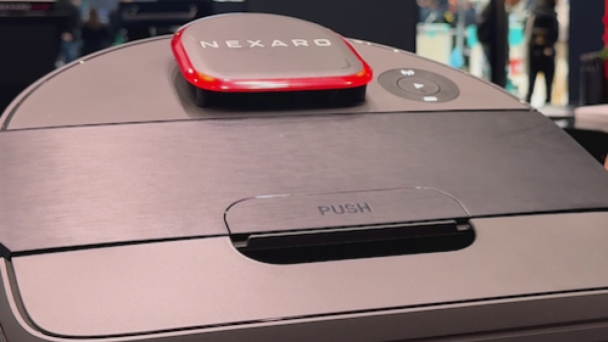
The Nexaro NR 1700 AI-powered robotic vacuum cleaner met all our professional expectations and curiosity – and it quickly became clear that this would be the technology through which Fort enters the age of robotics.
What makes the Nexaro NR 1700 special?
This robotic vacuum isn’t designed for home use – it’s built specifically for professional environments such as offices, hotels, showrooms, and large open spaces requiring daily maintenance.
Key features:
- Battery runtime: up to 250 minutes (eco mode)
- Maximum cleaning area: 1,000 m² Dust bin capacity: 1.4 liters
- Filter: washable HEPA H13
- Navigation: laser distance sensor (LDS) + AI-based mapping
- Target market: professional cleaning service providers, offices, hotels
What truly sets Nexaro apart is its AI-driven navigation and mapping system, which allows the robot to confidently operate in complex environments – whether filled with furniture or featuring mixed flooring types.
No camera, just laser
The Nexaro NR 1700 doesn’t use a camera to detect its surroundings – it relies on lidar-based (laser) sensing. This is not only a technological advantage but also a GDPR-compliant solution: since the robot doesn’t record images, it doesn’t process any personal data.
For us, who often work in spaces frequented by people, this was a crucial factor. Choosing Nexaro was not just a technological decision – it was an ethical one.
Co-bots, not competitors
For many, robotics still raises concerns about “machines taking over human jobs.” But we see things differently: robots don’t replace – they complement.
At Fort, working with “co-bots” (collaborative robots) represents a new, natural symbiosis. While human colleagues handle fine-tuning, detail work, and quality control, robots perform repetitive tasks with stability, efficiency, and precision.
Our goal isn’t to deploy fleets of robots everywhere overnight. Rather, we aim to integrate these technologies gradually, based on experience, in areas where they truly add value.
The beginning of a new era
Our collaboration with Nexaro marks not just the introduction of a new technological tool, but the evolution of Fort Facility’s mindset.
Human-machine cooperation is no longer a vision of the future – it’s the reality of today.
And our mission remains unchanged:
Whether human or robot – our shared goal is to create a clean, healthy, and sustainable environment.